
The four parts of an online casino
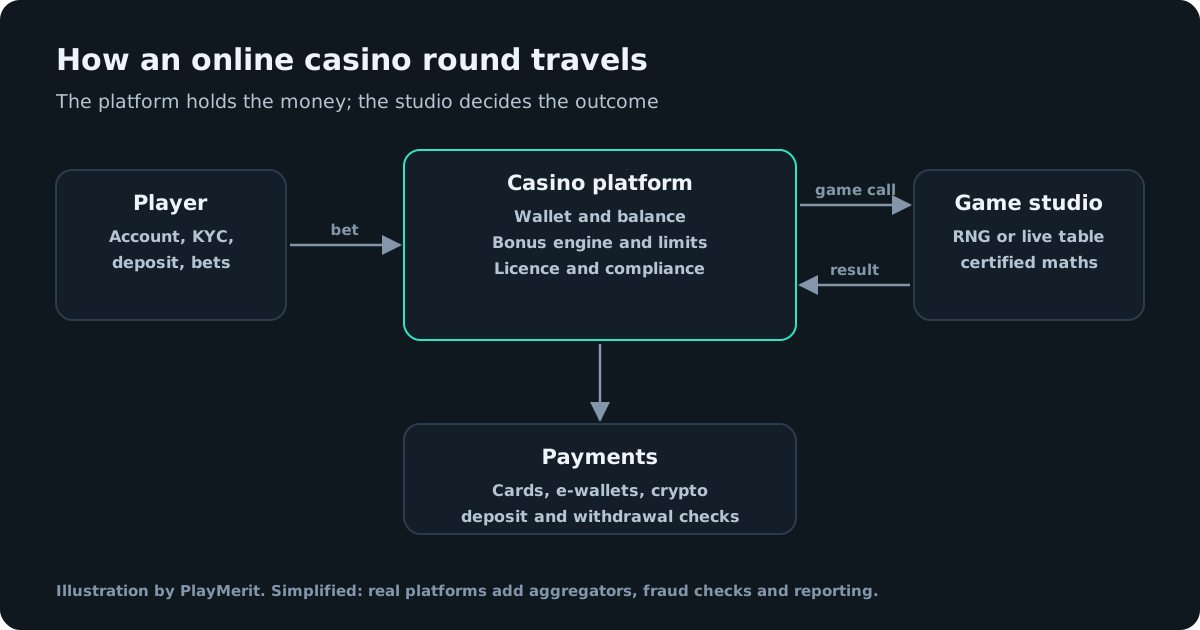
The operator and its platform. This is the brand you sign up with. Its platform runs your account, balance, bonus rules, limits and identity checks. The operator holds the licence and is the company you have a contract with.
Game studios. Most casinos do not build their own slots or tables. They license games from studios, often through an aggregator that connects hundreds of titles with one integration. When you open a slot, the game usually runs on the studio's servers and reports the result back to the casino.
Payment providers. Cards, bank transfers, e-wallets and, at crypto casinos, wallet addresses on one or more blockchains. The cashier is where deposit minimums, network choices, fees and withdrawal rules live.
The regulator. A licence sets rules on fairness testing, player funds, identity checks, advertising and complaints. How strict those rules are depends on who issued the licence, which is why our reviews name the regulator and licence number.
Random number generators and certified maths
Digital games such as slots, roulette and blackjack use a random number generator (RNG): software that produces unpredictable numbers, which the game turns into reels, cards or a ball position. In regulated markets the RNG and the game maths are tested by an independent lab before release. The UK Gambling Commission's remote technical standards are a good example of what those rules cover, from the quality of the randomness to how game information is displayed.
Two things follow from this. First, a certified RNG has no memory, so a run of losses does not make a win "due". Second, fairness testing checks that the game matches its published maths. It does not mean the maths is in your favour.
Live dealer games
Live casino games are filmed in studios with real dealers, real cards and real wheels, then streamed to your screen. Your bets are placed through the casino interface, and the dealer's results are read by cameras and sensors. Live games feel more transparent because you can watch the shuffle or the spin, but the house edge comes from the rules and payouts just as it does in an RNG game.
RTP and the house edge
Every game has a theoretical return to player (RTP): the share of all stakes it pays back over a very large number of rounds. A slot with 96% RTP has a 4% house edge. The UK regulator's explanation of return to player stresses the key point: RTP is a long-run average across all players, not a forecast for your session.
Many slots come in several RTP versions, and the casino chooses which one to run. The figure in the game's own help screen is the one that applies at that casino. Our guide to RTP and house edge shows how to find it and how to read it.
The wallet: deposits, balances and withdrawals
When you deposit, the money goes to the operator, not to the game studio. Your balance often has two parts once a bonus is involved: real money you can withdraw and bonus money that is locked until you meet the wagering requirement. The order in which those balances are used changes what you can cash out, which is why we cover it in detail in the bonuses, wagering and withdrawals guide.
Withdrawals pass through more checks than deposits. Expect some or all of these:
- Identity checks (KYC). Many casinos ask for ID and proof of address before the first withdrawal or above a threshold.
- Pending time. Some casinos hold a withdrawal for review before sending it.
- Limits. Daily, weekly or monthly caps on how much can be paid out.
- Network or method fees. For crypto, the blockchain fee depends on the network you choose.
Our fast withdrawal casinos list compares these rules side by side.
How the casino makes money
The casino's income is the gross gaming revenue: stakes minus winnings paid. With a house edge on every game, a large number of bets produces a fairly steady margin for the operator, even though individual players win and lose in unpredictable ways. Poker rooms take a small cut of each pot (the rake), and sportsbooks build a margin into their odds.
Bonuses, cashback and rakeback are marketing costs paid out of that margin. They can be genuinely useful to players, but they are designed so the casino still earns on average. We explain how to tell a generous offer from an expensive one in how casino bonus systems work.
What a licence does and does not tell you
A licence means a regulator has approved the operator and can act if rules are broken. It does not mean the casino is legal in your country, and licences differ a lot in what they require. Before signing up, check three things: who issued the licence, whether your country is on the casino's restricted list, and whether online casinos are legal where you live. If you are curious how this patchwork came about, our short history of gambling covers the first online licences of the 1990s.
A quick checklist before you sign up
- Find the licence number and regulator in the site footer or terms.
- Read the withdrawal rules: limits, pending time, KYC and fees.
- Open the help screen of the games you plan to play and note the RTP.
- If you take a bonus, read the wagering multiple, the eligible games and the maximum bet.
- Set deposit and loss limits before your first deposit. Our responsible gambling guide shows how.
FAQ
Are online casino games rigged?
Games from licensed studios are tested so that results match their published maths. They are not rigged against individual players, but every game has a built-in house edge, so the casino wins on average over many bets.
Who decides the result of a slot spin?
The game's random number generator, which usually runs on the game studio's server. The casino receives the result and updates your balance.
Why do withdrawals take longer than deposits?
Withdrawals go through identity, fraud and limit checks that deposits do not, and some casinos review each request before paying. Crypto withdrawals also depend on the blockchain network you choose.
Does a licence mean a casino is legal in my country?
No. A licence covers the operator under that regulator's rules. Whether you may play depends on the law where you live and on the casino's own list of restricted countries.