
Key facts at a glance
- When: the first wallets were drained at 20:05 UTC on 29 October 2026; the largest sweeps followed at 20:20 UTC (4:20 p.m. in New York).
- How much: Binance puts the total impact at about $6.3 billion. TRM Labs counts $6.36 billion at the prices of the moment each transfer was made.
- Where: hot wallets on ten blockchains: Ethereum, Bitcoin, Tron, XRP Ledger, Solana, Arbitrum, Optimism, Base, Avalanche and Polygon.
- Frozen: about $3 billion, mostly stablecoins blocked by Tether and Circle.
- Cause, per Binance: a compromised laptop of a DevOps engineer that gave the attacker access to a service container, which then submitted unauthorised withdrawals. Binance says it found no evidence that wallet private keys leaked.
- Who: TRM Labs attributes the attack "with high confidence" to TraderTraitor, a North Korean hacking unit linked to the Lazarus Group.
- Users: Binance says user funds are safe and that it will cover all losses from its SAFU fund and company funds.
What happened on 29 October
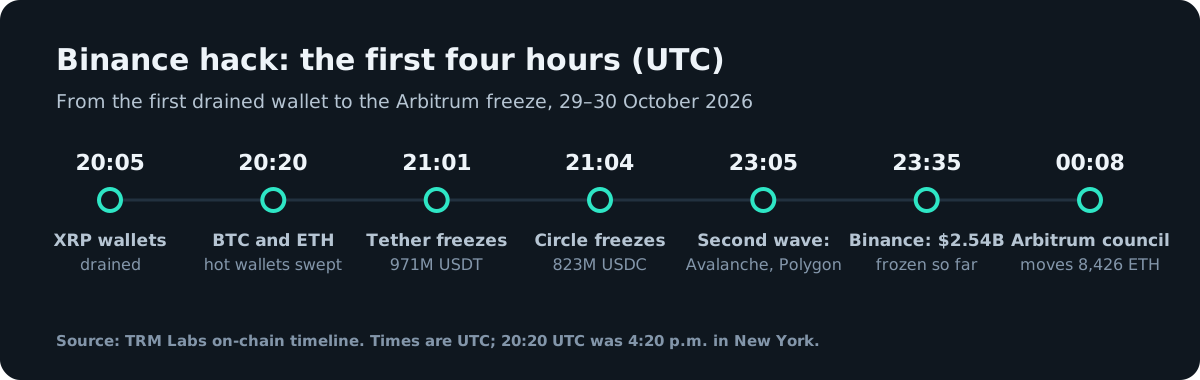
The attack had been prepared in advance. According to TRM Labs' on-chain reconstruction, the attacker's operating wallet received three small withdrawals from the Tornado Cash mixer on 28 October. Early on 29 October the attacker deployed the code later used in the theft, tested it on two wallets and rehearsed the final version on a third. About four hours after the rehearsal, the same code was installed on a Binance hot wallet.
Then the money started moving:
| Time (UTC) | What happened |
|---|---|
| 20:05–20:09, 29 Oct | Five Binance wallets on the XRP Ledger send 233.46 million XRP to one attacker address |
| From 20:10 | Binance wallets on Solana and Optimism send funds out |
| 20:20 | The Bitcoin hot wallet sends 18,270 BTC to an attacker address |
| 20:20 | On Ethereum, a hot wallet is taken over and swept about three and a half minutes later: 167,464 ETH and 63 tokens, including 1.615 billion USDT |
| ≈ 20:22 | The Tron hot wallet sends 612.7 million USDT and 46.4 million TRX |
| 20:41–23:56 | The attacker sweeps the Ethereum wallet again six more times |
| 21:01 | Tether freezes 971.1 million USDT in the main receiving wallet |
| 21:04 | Circle freezes 823 million USDC in the same wallet |
| 23:05 | A second wave drains Binance wallets on Avalanche and Polygon |
| 23:35 | Binance says the verified frozen total has reached $2.54 billion |
| 00:08, 30 Oct | The Arbitrum Security Council moves 8,426 ETH and 74.6 million ARB out of an attacker wallet |
Users noticed first. People on social media reported funds draining from Binance wallets, and founder Changpeng Zhao posted on X that "it does look like a hack on Binance", adding that he no longer runs the exchange, as Bitcoin.com News and TechCrunch reported. Binance's first response was that it was "aware of reports of a potential security issue" and that "user funds are completely safe". A spokesperson told TechCrunch that withdrawals were "temporarily suspended on multiple networks following a security incident as a precautionary measure". At about 00:30 GMT on Friday, 30 October, Binance suspended all deposits and withdrawals, AFP reported.
How much was stolen
Binance's own figure, posted on X, is that "the estimated total impact sits at around $6.3B", a number it said "may continue to increase" as more assets are traced, according to NBC News. Independent estimates differ slightly, mainly because of which transfers they count and which prices they use:
| Who | Estimate |
|---|---|
| Binance | about $6.3 billion |
| TRM Labs | $6.36 billion at transfer-time prices ($6.23 billion at later prices) |
| Chainalysis | about $5.9 billion at the time of the theft (via CoinDesk) |
| Glassnode | about $5.3 billion (via Bitcoin.com News) |
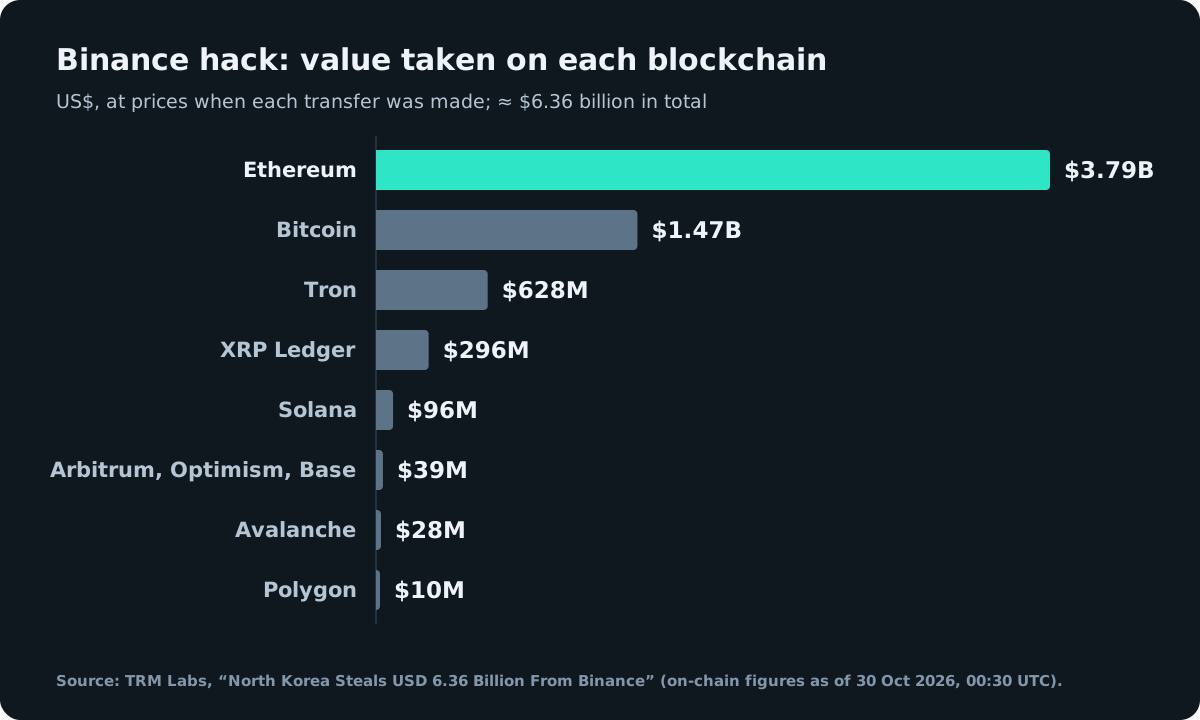
TRM Labs' breakdown by blockchain shows that Ethereum and Bitcoin account for more than 80% of the loss:
| Blockchain | Assets taken | Value |
|---|---|---|
| Ethereum | 200,630 ETH and 185 other tokens, including 1.875 billion USDT, 823 million USDC and 88.5 million RLUSD | ≈ $3.79 billion |
| Bitcoin | 18,270 BTC | ≈ $1.47 billion |
| Tron | 612.7 million USDT and 46.4 million TRX | ≈ $628 million |
| XRP Ledger | 233.46 million XRP | ≈ $296 million |
| Solana | 970,500 SOL | ≈ $96 million |
| Arbitrum, Optimism and Base | including 74.6 million ARB | ≈ $39 million |
| Avalanche | various tokens | ≈ $28 million |
| Polygon | various tokens | ≈ $10 million |
| Total | ≈ $6.36 billion |
For scale: according to DefiLlama data cited by CoinDesk, Binance held about $144 billion in assets before the attack, so the loss is roughly 4% of its holdings. The theft is about four times the size of the Bybit hack of 21 February 2025, which the FBI put at about $1.5 billion. For a sense of the wider picture, TRM's 2026 Crypto Crime Report counted $2.87 billion stolen in nearly 150 hacks during the whole of 2025, as Al Jazeera notes. The Binance theft alone is more than twice that.
What Binance says
Binance has published its updates on X. In order:
- "User funds are safe." The exchange repeated this from its first statement onwards.
- Losses will be covered. Co-founder and co-CEO Yi He wrote that "Binance will cover all hacking losses" and promised "a full post-mortem once the investigation is complete". Binance said it would pay from its SAFU fund and company funds. SAFU, the Secure Asset Fund for Users, was set up in 2018 and holds roughly $1 billion in bitcoin, according to CoinDesk, so most of the cover would have to come from company money.
- The cause. "Binance's initial investigation suggests that the security incident may involve a compromised DevOps engineer's laptop," the exchange said. That gave the attacker access to "a service container" from which it could "submit unauthorized withdrawal transactions". Binance said it found "no evidence of any private key leaks from wallets". A later update said several factors contributed and that the security team was still tracing the full attack path, as CyberInsider reported.
- Containment. Binance said it had revoked authorisation for the affected address and was working with law enforcement, token issuers and blockchain intelligence firms. "This figure may continue to increase," it said of the roughly $3 billion frozen so far.
- Deposits and withdrawals. After the full pause, Yi He said that "deposits remain unaffected and continue to operate as normal", that the team was "working on enhancements to the withdrawal service and related address controls", and that "we expect to begin resuming withdrawal services in the next 48 hours", as quoted by AMBCrypto.
- Next steps. Binance plans to publish an updated Proof of Reserves after the clean-up and a detailed technical post-mortem.
Changpeng Zhao, who stepped down as CEO in 2023 and remains Binance's largest shareholder, added: "As a shareholder, I expect all user funds will be fully covered."
How much has been frozen
Unlike bitcoin or ether, the biggest stablecoins can be frozen by the companies that issue them. That made the race to freeze the single most important factor in how much the attacker keeps.
| Who froze | Amount |
|---|---|
| Tether (USDT) | about $1.57 billion, per CEO Paolo Ardoino; TRM counts about $1.77 billion across several wallets and chains |
| Circle (USDC) | more than $800 million, per CEO Jeremy Allaire; about $825 million per TRM |
| Ripple (RLUSD) | 40.5 million RLUSD on-chain; Yi He said Ripple helped stop about $200 million from moving |
| World Liberty Financial (USD1) | about $27.8 million |
| Arbitrum Security Council | 8,426 ETH and 74.6 million ARB, about $30 million |
TRM put the total at about $2.7 billion as of 00:30 UTC on 30 October; Binance later said about $3 billion had been frozen on-chain. A frozen token cannot be moved, but it is not yet back with Binance: returning it takes a separate process with each issuer and, usually, law enforcement. Aave also froze its affected lending markets after the attacker used them, saying its own contracts were not affected.
What is out of reach is the native coins. TRM estimates the attacker still holds more than 420,000 ETH and the 18,270 BTC, roughly $2.4 billion that no issuer can freeze. The details of how the attacker swapped, borrowed and split those funds are in part two.
Who is behind the attack
Several blockchain investigators point to North Korea:
- TRM Labs assessed "with high confidence" that the attack was carried out by TraderTraitor, the North Korean unit the FBI blamed for the Bybit theft, citing "robust on and off-chain intelligence".
- Chainalysis also linked the theft to TraderTraitor, and investigator ZachXBT named the Lazarus Group as the likely attacker.
- Blockaid CEO Ido Ben-Natan said its findings were consistent with North Korean operations and called it "the biggest crypto hack in history".
The US Justice Department and the FBI did not immediately respond to AFP's request for comment. TRM's Ari Redbord called the attack "unprecedented" and a "watershed", adding that theft on this scale funds North Korea's weapons programmes, which makes it a global security issue. The evidence behind the attribution is covered in part two.
How the markets reacted
Prices fell as the news spread on Thursday. According to CoinDesk, bitcoin dropped 4.8% to below $77,000, ether 5.7%, Binance's own token BNB 8% and AAVE 11%. About $1.4 billion of leveraged positions were liquidated across the market over 24 hours, according to Coinglass data cited by Bitcoin.com News, although not all of that was caused by the hack. By about 04:00 GMT on Friday most of the fall had been recovered: AFP reported bitcoin and ether down 0.8%, and BNB up 2.7% after having fallen nearly 10%.
Sean Foley of Macquarie University told Al Jazeera that a blow to confidence in Binance could weigh on crypto prices and that the attack highlights the risks of keeping funds on centralised exchanges.
Has Binance been hacked before?
Yes, but never on this scale. On 7 May 2019 attackers took about 7,000 BTC, worth about $40.6 million at the time, from a single Binance bitcoin hot wallet, The Hacker News reported. That was about 2% of the exchange's bitcoin, and SAFU covered the whole loss. The 2026 attack is roughly 150 times larger in dollar terms and hit wallets on ten blockchains at once.
The same day as the Binance theft, prediction market Polymarket briefly halted trading after a separate incident involving a compromised third-party company, with losses of a few million dollars. TechCrunch reported it as a separate incident.
What it means for Binance users and crypto players
If you keep crypto on Binance, or move money through it to pay for other services, including crypto casinos, a few practical points apply:
- Expect withdrawal delays. While withdrawals are paused or limited, money on the exchange cannot reach another wallet or service. Avoid planning payments that depend on a Binance withdrawal until the service is fully back.
- Ignore "refund" and "verification" messages. Binance warned users to rely only on its official channels and not to follow unofficial links or requests for account details. Big hacks are always followed by phishing that impersonates the victim.
- Exchange balances are not insured. As NBC News points out, crypto on an exchange is not covered like a bank deposit; refunds depend on the exchange. Binance has promised full cover, but that is a company decision.
- Keep only what you need on any exchange. A self-custody wallet that you control removes the exchange as a point of failure, though it makes you responsible for your own keys and backups.
- Check the network before you send. When withdrawals return, choose the same network on both sides. Our list of USDT casinos shows which networks each casino accepts, and the fast withdrawal casinos page compares payout times.
Whatever happens with exchanges, gambling is for adults only and carries a real risk of loss; our responsible gambling guide lists tools and help lines.
FAQ
Was Binance hacked?
Yes. On 29 October 2026 Binance confirmed a security incident in which attackers drained its hot wallets on ten blockchains. Binance puts the total impact at about $6.3 billion.
How much money was stolen from Binance?
About $6.3 billion according to Binance and $6.36 billion according to TRM Labs, at the prices when the funds were moved. About $3 billion of that has been frozen, mostly USDT and USDC.
Are Binance user funds safe?
Binance says user funds are safe and that it will cover all losses from its SAFU fund and company funds. Founder Changpeng Zhao said he expects all user funds to be fully covered.
When will Binance withdrawals resume?
Deposits work normally. Co-CEO Yi He said Binance expects to begin resuming withdrawals within 48 hours of her update on 30 October, after changes to the withdrawal service and address controls.
Who hacked Binance?
Blockchain intelligence firm TRM Labs attributes the attack with high confidence to TraderTraitor, a North Korean state hacking unit linked to the Lazarus Group. Chainalysis, ZachXBT and Blockaid also point to North Korea.
Is this the biggest crypto hack ever?
Yes. At about $6.3 billion it is roughly four times larger than the $1.5 billion Bybit hack of February 2025, the previous record.
Sources
- TRM Labs: North Korea steals USD 6.36 billion from Binance
- CoinDesk: Binance loses over $6 billion in the largest crypto hack to date
- NBC News: Binance targeted in $6.3 billion crypto heist
- AFP via Yahoo Finance: Binance confirms $6.3 bn hack
- Al Jazeera: Binance says $6.3bn stolen in biggest crypto heist in history
- TechCrunch: Binance pauses withdrawals
- Bitcoin.com News: inside the Binance hack
- CyberInsider: Binance links the incident to a compromised laptop
- AMBCrypto: Binance to resume withdrawals within 48 hours
- FBI: North Korea responsible for $1.5 billion Bybit hack
- The Hacker News: Binance hot wallet hack of May 2019