

The first games of chance
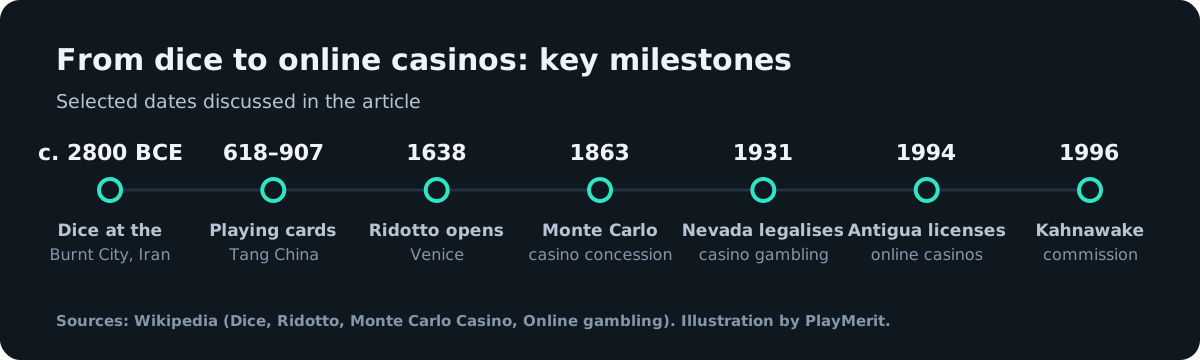
The oldest dice found so far come from Shahr-e Sukhteh, the "Burnt City" in south-eastern Iran. They were part of a backgammon-like set and are dated to roughly 2800–2500 BCE, according to the overview of the history of dice. Before standardised cubes, people threw knucklebones from sheep and goats, and the habit of reading meaning into a random throw sits somewhere between fortune-telling and play.
What matters for our story is that a die is a simple random number generator. Six faces, each equally likely on a fair cube. Every casino game since then, from roulette to a video slot, is built on the same idea: an outcome nobody can predict, paid at odds that are slightly less generous than the true chance.
Cards travel from China to Europe
Playing cards appear in China during the Tang dynasty (618–907), as summarised in the history of the playing card. They spread west along trade routes and reached Europe by the late fourteenth century, where the suits we know today slowly settled into shape.
Cards changed gambling because they added memory and choice. With dice, every throw is independent. With a deck, cards already dealt change what can still come, and a player's decisions start to matter. That difference still separates games such as blackjack and poker from pure games of chance.
Venice opens a legal casino in 1638
For most of history, gambling happened in taverns, private houses and at fairs, and authorities alternated between taxing it and banning it. In 1638 Venice's Great Council tried a third option: it opened the Ridotto, a government-run gaming hall in a wing of Palazzo Dandolo, during the carnival season. It is usually described as Europe's first state-sanctioned casino.
The Ridotto set rules that look familiar. Play was supervised, stakes were controlled and the house took a predictable share. It also showed the downside early. Venetian nobles lost family fortunes, and the hall was closed in 1774 after a reform motion passed by an overwhelming majority.
Spa towns and Monte Carlo
In the nineteenth century, European spa towns such as Baden-Baden and Bad Homburg turned casinos into part of a resort holiday. One of the people who ran the Bad Homburg casino, François Blanc, was persuaded to move to Monaco, and in 1863 he took over the principality's casino business through the company that became the Société des Bains de Mer. The Monte Carlo casino grew into the model for the glamorous European casino, with Charles Garnier, the architect of the Paris opera house, expanding the building in the late 1870s.
Monte Carlo also popularised single-zero roulette. With one green zero on a 37-pocket wheel, the house edge on an even-money bet is 1/37, about 2.7%. American wheels later added a double zero, which nearly doubles that edge. The game looks the same; the maths does not, which is why we always point readers to the rules of the exact version they play.
Nevada and the resort casino
Nevada legalised casino gambling in 1931, during the Great Depression, and Las Vegas spent the next decades turning the casino into the centre of a hotel, show and restaurant complex. The business model shifted from a single gaming room to entertainment built around the games, with the house edge quietly paying for much of it.
The American era also brought regulation that is closer to what online players see today: licensing of owners, technical rules for machines and dedicated gaming boards that can fine or close an operator.
The internet changes everything (1994–1998)
The jump to online play happened fast. In 1994 Antigua and Barbuda passed its Free Trade and Processing Act, which allowed licences for companies that wanted to run online casinos, and the first internet casinos went live that same year. In 1996 the Kahnawà:ke Gaming Commission was set up to regulate interactive gaming from the Mohawk Territory of Kahnawà:ke, near Montreal, and it still licenses operators today.
The numbers in the history of online gambling give a sense of the speed: about 15 gambling websites in 1996, around 200 a year later, and the first online poker rooms in 1998. Software companies built complete casino platforms, card payments and later e-wallets handled the money, and the casino left the building.
Regulation catches up
Over the following two decades, more countries chose to license online gambling rather than leave it offshore. The UK built one of the most detailed rule books, including technical standards for random number generators and rules about how return-to-player figures are shown. Many other countries followed with their own licences, while some kept online casinos illegal. The result is the patchwork we have today: the same game can be legal, licensed and taxed in one country and prohibited across the border.
That patchwork is the reason every review on PlayMerit lists the licence and the countries a casino excludes, and why you should always check whether online casinos are legal where you live before you sign up anywhere.
What history teaches players
Five thousand years of gambling leave a few lessons that apply to any modern casino:
- The house wins on average. From the Ridotto to an online slot, the operator sets payouts slightly below the true odds. Our guide to RTP and house edge explains how to read those percentages.
- Rules beat appearances. Single-zero and double-zero roulette look alike, but the edge is not the same.
- Regulation is local. A licence from one regulator does not make a casino legal everywhere.
- Losses have always hurt real people. Venice closed its casino because of them. If you play, set limits first; our responsible gambling guide lists practical tools and where to get help.
FAQ
What is the oldest known gambling game?
Dice are the oldest gambling tools we have physical evidence for. The earliest known set, from the Burnt City in Iran, dates to around 2800–2500 BCE.
What was the first casino?
The Ridotto in Venice, opened in 1638 by the city's Great Council, is generally described as the first state-sanctioned casino in Europe. Gambling houses existed earlier in other parts of the world, including China.
When did online casinos start?
The first online casinos launched in 1994, the same year Antigua and Barbuda passed the law that allowed it to license them. The Kahnawà:ke Gaming Commission followed in 1996.
Has the house edge always existed?
Yes. Organised gambling has always paid winners slightly less than the true odds. That margin is how a casino covers its costs and makes a profit, whether it is a Venetian hall or a website.