
2008–2009: a new kind of money
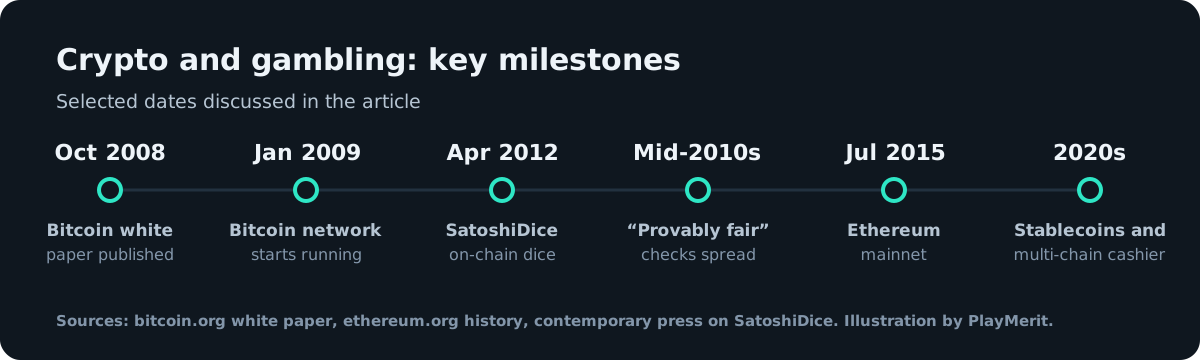
On 31 October 2008, a person or group using the name Satoshi Nakamoto published Bitcoin: A Peer-to-Peer Electronic Cash System. The paper described a way to send value directly between two people without a bank in the middle, using a public ledger secured by computing power. The network started running in January 2009.
For gambling, three properties mattered immediately. Payments did not need a card network or bank approval. They settled in minutes rather than days. And every transaction was recorded publicly, which meant a game could, in principle, be checked by anyone.
2012: the dice sites
The best-known early example was SatoshiDice, launched in 2012. Players sent bitcoin to an address that represented a bet with fixed odds, and the result was calculated from the transaction itself, with the payout sent straight back. There was no account, no sign-up form and no cashier. At its peak the site handled a large share of all activity on the Bitcoin network.
It was also a real business. In July 2013 its founder announced that SatoshiDice had been sold for the equivalent of about $11.5 million in bitcoin, as reported by Bitcoin Magazine at the time. The same report describes a small but growing ecosystem of bitcoin poker rooms, lotteries and casino-style sites.
"Provably fair": checking the result yourself
Early crypto gambling sites popularised a verification method that came to be known as "provably fair". The usual version works like this:
- Before you bet, the casino commits to a secret server seed by showing you its cryptographic hash.
- You add your own client seed, and each bet has a counter called a nonce.
- The result is calculated from the combination of those values.
- Later, the casino reveals the server seed. You can hash it to confirm it matches the commitment and recompute every result.
Because the casino committed to its seed before you chose yours, it cannot pick a seed that beats your bet. Provably fair systems do not change the house edge, though: they prove the game followed its published rules, and those rules still favour the house. Our guide to RTP and house edge explains what that edge means over time.
2015: smart contracts and new tokens
Ethereum launched its main network on 30 July 2015, according to the project's own history page. It added programmable smart contracts to the idea of a blockchain, which opened the door to on-chain games, tokens issued by casinos and, later, NFTs used as in-game items. Most real-money casino play still happens off-chain on the casino's own servers, but Ethereum and the networks that followed shaped how crypto casinos accept deposits and run loyalty schemes.
Stablecoins and the multi-chain cashier
The biggest practical change for players in recent years has been stablecoins such as USDT and USDC, tokens designed to hold a steady value against the US dollar. They remove the price swings that make a bitcoin balance hard to budget with. Today a typical crypto casino cashier accepts several coins on several networks, and choosing the right network matters: fees and confirmation times differ a lot between them. Our USDT casinos list shows which networks each casino supports.
What crypto changed, and what it did not
Crypto changed how money moves:
- Speed. Withdrawals can arrive in minutes once approved, rather than days. See our fast withdrawal casinos.
- Access. No card network or bank approval is needed to deposit.
- Rewards. Crypto casinos compete hard on rakeback, cashback and VIP programmes, covered in how casino bonus systems work.
It did not change the fundamentals:
- The house edge is the same. A slot pays the same RTP whether you bet in dollars or in bitcoin.
- Licences still matter. Crypto casinos are licensed by regulators such as Curaçao or Anjouan, and many still run identity checks before withdrawals.
- Volatility is extra risk. A balance held in a volatile coin can lose value while it sits in your account.
- Taxes and local law still apply. Paying in crypto does not make gambling legal where it is not, and it may have tax consequences where you live.
FAQ
What was the first bitcoin gambling site?
SatoshiDice, launched in 2012, is the best-known early bitcoin gambling site and one of the first to attract mainstream attention. Smaller sites existed around the same time.
What does provably fair mean?
It is a method that lets you verify each result. The casino commits to a hidden server seed in advance, you add a client seed, and after the bet you can check that the result came from those values without manipulation.
Are crypto casinos fairer than regular online casinos?
Not automatically. Provably fair games let you verify results, and licensed regular casinos use independently tested RNGs. In both cases the house edge is built into the game.
Why do crypto casinos use stablecoins?
Stablecoins such as USDT and USDC keep a steady value against the US dollar, so your balance does not rise or fall with the crypto market while you play.